BenQ respect your data privacy. We use cookies and similar technologies to ensure you get the best experience when visiting our website. You can either accept these cookies by clicking “Accept Cookies”, or click “Only Required Cookies” to refuse all non-essential technologies. You can customise your cookie settings here at any time. For further information, please visit our Cookie Policy and our Privacy Policy.
Page updated: May 2020
Some essential features on BenQ sites just won’t work without cookies. And having other cookies switched off can seriously affect the way you’ll be able to enjoy our services.
Please check your cookie settings below and turn on any cookies you’re happy with.
“Strictly necessary” cookies can’t be turned off. But Functional and Performance cookies can be turned on or off below. You can learn more about cookies and what they do on our other pages.
If you've chosen to block third-party cookies on your browser, your cookie preferences won't carry over from benq.eu to benq.xx and vice versa. Please make sure to set your cookie preferences in both places.
On
These cookies are essential so that you can move around the website and use its features. Without these cookies services you have asked for cannot be provided.
On
Off
These cookies allow the website to remember choices you make to give you better functionality and personal features.
On
Off
Performance cookies
These cookies help to improve the performance of BenQ. If you want to opt-out of advertising cookies, you have to turn-off performance cookies. We also use Google Analytics, SessionCam and Hotjar to track activity and performance on the BenQ website. You can control the information provided to Google, SessionCam and Hotjar. To opt out of certain ads provided by Google you can use any of the methods set forth here or using the Google Analytics opt out browser add-on here. To opt-out of SessionCam collecting data, you can disable tracking completely by following link:https://sessioncam.com/choose-not-to-be-recorded/. To opt-out of Hotjar collecting data, you can disable tracking completely by following link:https://www.hotjar.com/privacy/do-not-track/.
Advertising cookies
These cookies are used to track your activity on the BenQ website and other websites across the Internet, help measure the effectiveness of our advertising campaign and deliver advertisements that are more relevant to you and your interests. We use various advertising partners, including Amazon, Facebook, and Google. These cookies and other technologies capture data like your IP address, when you viewed the page or email, what device you were using and where you were. You can find out how to avoid them below.
BenQ respect your data privacy. We use cookies and similar technologies to ensure you get the best experience when visiting our website. You can either accept these cookies by clicking “Accept Cookies”, or click “Only Required Cookies” to refuse all non-essential technologies. You can customise your cookie settings here at any time. For further information, please visit our Cookie Policy and our Privacy Policy.
Projector
Explore Business Projector
Professional Installation Exhibition & Simulation Conference Room Meeting Room Education ProjectorsMonitor
Lighting
Interactive Display | Signage
As technology continues to advance in recent years, the modern workforce is focusing more on enhancing productivity and efficiency at work. For design professionals, one of the tasks that they perform on a regular basis is transmitting different types of data, signals or files from one device to another through different types of cables. Traditionally, figuring out which cable to use can be a chaotic process, as cables often look identical to each other at a glance. Picking the wrong cable can unnecessarily compromise the transmission speed.
To further satisfy designers’ needs for efficiency and productivity, several transmission protocols have been introduced in recent years. Among them, Thunderbolt™ 3 and USB 3.1 Gen2 Type C often create confusion among end users. So what are the differences between these two transmission cables?
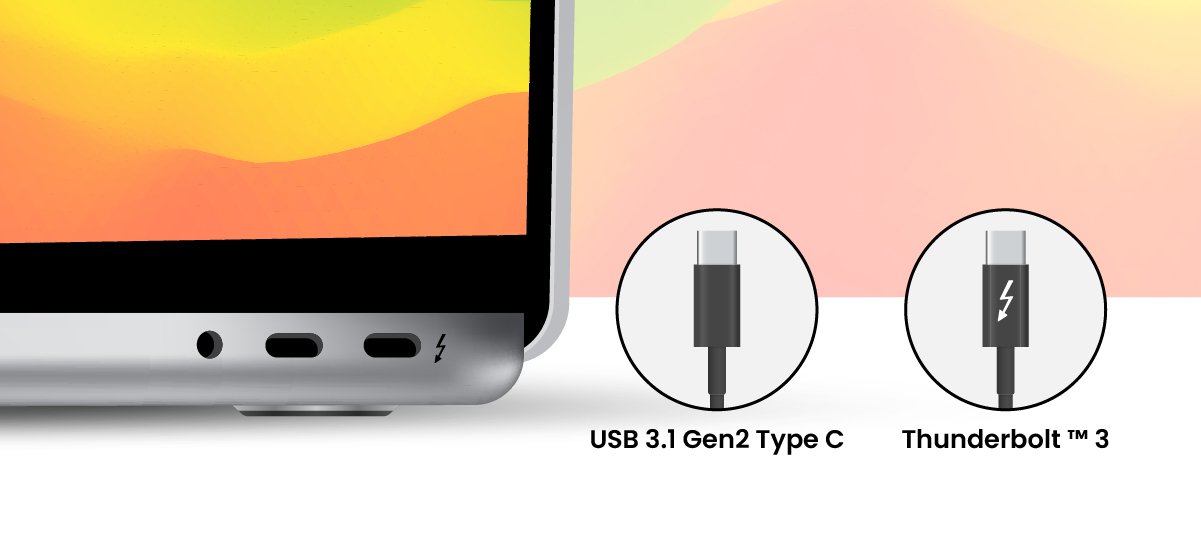
One of the reasons why users often get confused between Thunderbolt™ 3 and USB 3.1 Gen2 Type C is because the shape of both cables’ plugs looks exactly the same. However, the same plug is paired up with different transmission protocols. In other words, both cables are equipped with USB-C™ plugs but they each have their own transmission protocols, which are Thunderbolt™ 3 and USB 3.1.
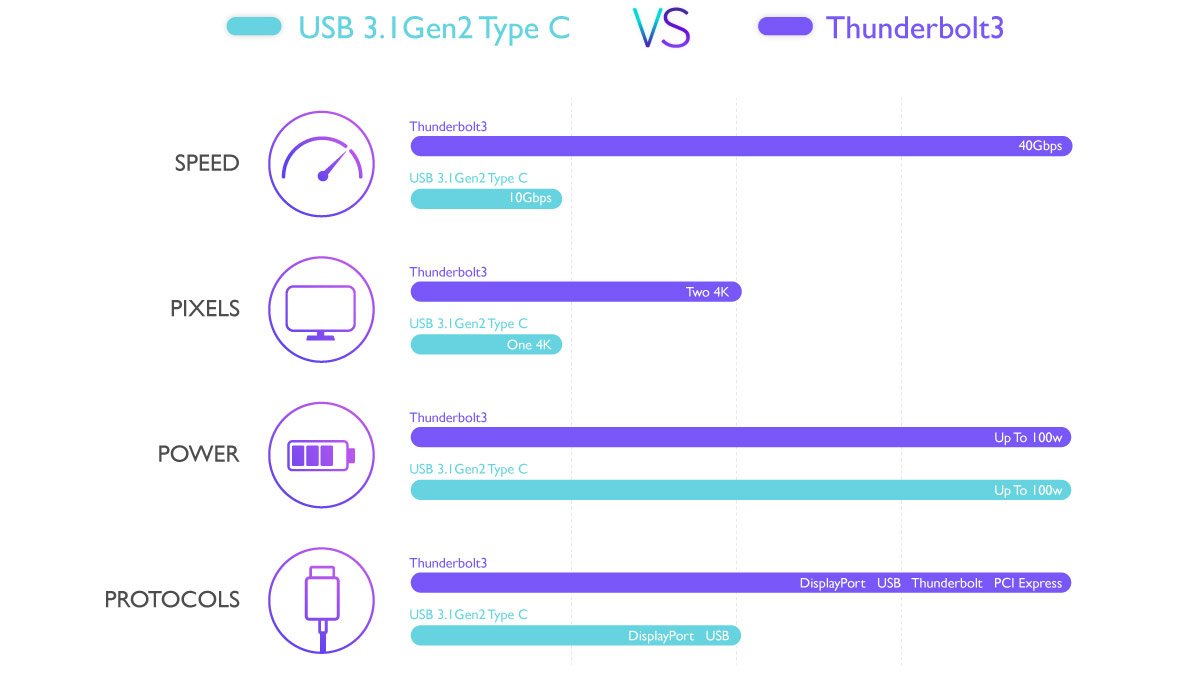
Despite the difference in transmission protocols, Thunderbolt™3 and USB 3.1 Gen2 Type C can share the same USB-C™ port. For example, if users connect a USB-C™ laptop to a Thunderbolt™ 3 monitor, they can still be used as a set. The only difference is due to USB3.1 Gen2’s bandwidth limitation, the transmission bandwidth will go down from 40 Gb/s to 10 Gb/s.
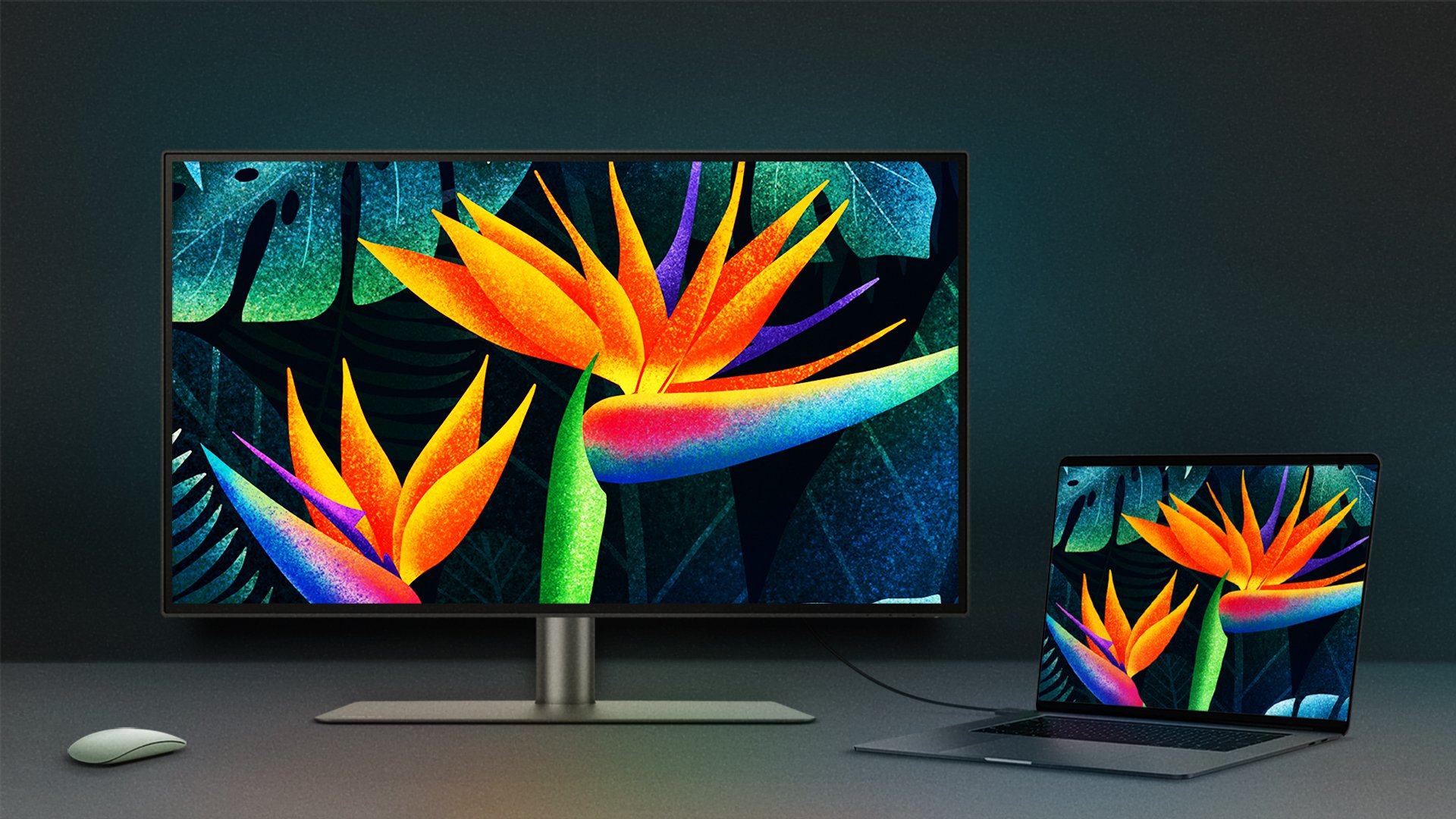
Therefore, users need to make sure that their laptop’s USB-C port supports DisplayPort Alt mode. That is a mode which allows their USB-C equipped laptop to connect directly to a Thunderbolt™ 3 or USB-C™ monitors. Additionally, since there are several protocols for USB-C ports, users then must make sure what their laptop’s USB Typc C port supports, whether it’s DisplayPort Alternative Mode or power charging, so as to guarantee the monitor or laptop can enjoy the convenience that comes with the USB-C one cable solution.
So which one is better, Thunderbolt™ 3 or USB3.1 Gen2 Type C? A quick comparison shows that Thunderbolt™ 3 offers a higher bandwidth, which enables it to support two 4K monitors while offering a faster data transmission speed. Additionally, comparing to USB 3.1 Type C, Thunderbolt™ 3 is also compatible with more transmission protocols, meaning that it can be used with more types of devices. In case you need to connect multiple monitors while working, Thunderbolt™ 3 is able to accomplish the task through its daisy chaining feature, allowing designers to display one large image across several monitors that are daisy-chained up.
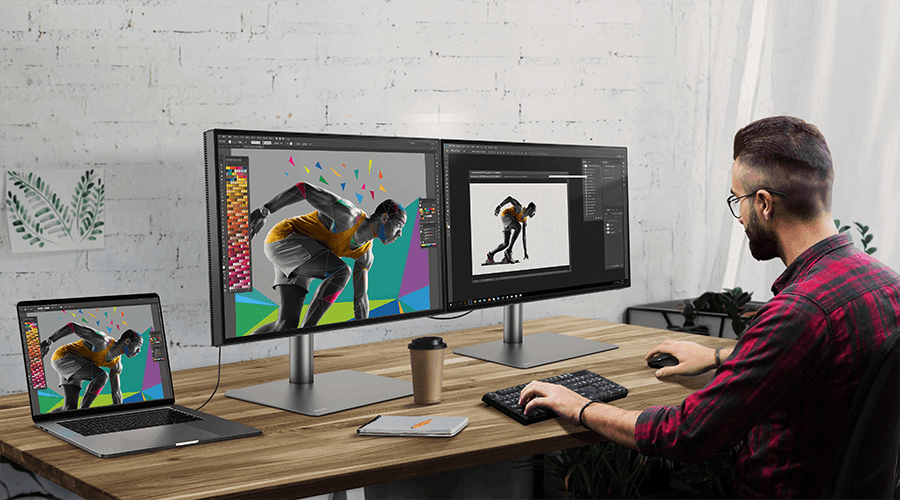
For designers with demands to use two 4K monitors at work, Thunderbolt™ 3 is the better choice because USB-C™ can only support one 4K monitor. If you only require one 4K monitor and have budgetary concerns, USB-C™ monitors would sufficiently serve your purpose. Additionally, since Thunderbolt™ 3’s bandwidth is higher, when designers finish their works and are ready to send their files, it takes less time when they are using Thunderbolt™ 3. In case you need to transfer files of larger sizes such as videos, Thunderbolt™ 3 is the more ideal option, whereas if you are mostly transferring files of smaller sizes, maybe you don’t necessarily need Thunderbolt™ 3.
So if you often require higher efficiency at work, Thunderbolt™ 3 may be a better option for you. After all, faster transmission and wider compatibility can equal to enhanced productivity and efficiency at work.
32 inch 4K Thunderbolt 3 Monitor with Display P3
Thanks for your feedback!